
What is a Financial Forecast?
In short, a financial forecast is a projection of a school district’s financial outlook over the current year and the three subsequent years. It represents the district’s best estimate of its expected General Fund revenues, expenditures and cash balance. While a school district has many funds to account for different activities, the General Fund is its primary operating fund, covering day-to-day operating activity revenue and expenses.
For Midview, the forecast is an important financial management tool that helps us:
Understand our financial outlook and how our revenues and expenses are expected to change over time.
Keep our community informed about the district’s financial position and the factors that influence it.
Make strategic decisions about staffing, programming, facility needs and other district priorities.
Plan for future funding needs. The forecast helps us identify if and when additional local revenue may be needed, giving us time to consider options, plan accordingly and communicate with our community.
Identify potential financial challenges early so we can make informed adjustments and address concerns before they become more difficult to manage.
Ohio law requires city, local, exempted village and joint vocational school districts to submit financial forecasts to the Ohio Department of Education and Workforce twice each year, in August and February.
Understanding the key lines of our forecast:
Revenues:
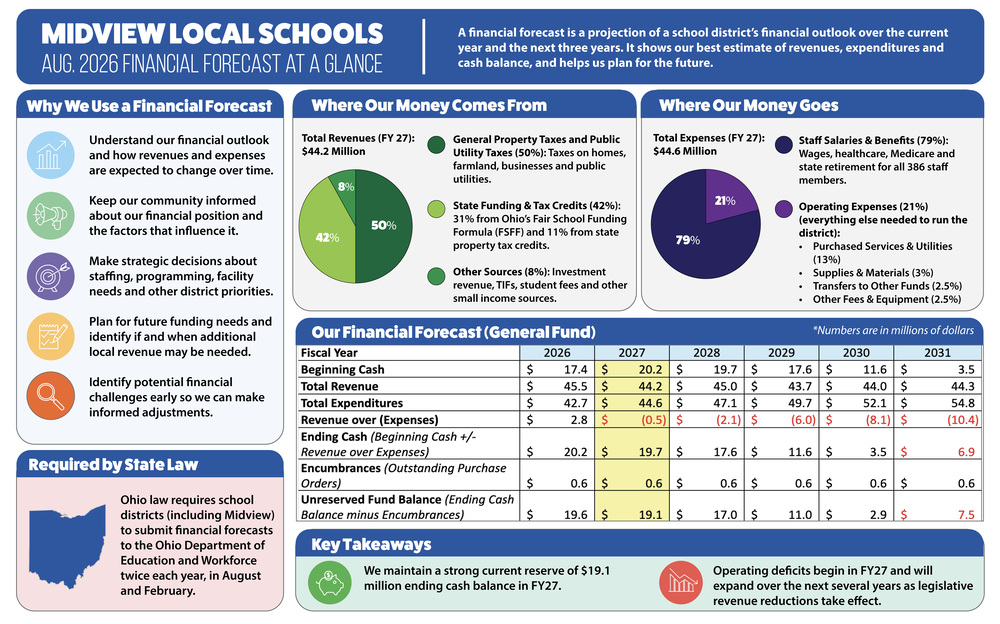
General Property Taxes and Public Utility Taxes (50% of revenue): This is our largest source of funding. It includes taxes on homes, farmland, businesses, and public utility infrastructure (like power lines, natural gas pipelines, and railroads).
State Funding & Tax Credits (42% of revenue): 31% comes from Ohio's Fair School Funding Formula (FSFF)—the state system that calculates district aid based on their perceived cost to educate a student. The remaining 11% comes from state property tax credits that reimburse the district for relief given directly to local homeowners.
Other Sources (8%): The remaining portion comes from investment revenue, local township/city development agreements (TIFs), student fees, and other small income sources.
Expenditures:
Staff Salaries & Benefits (79% of expenses): Like most service organizations, our people are our biggest investment. This covers wages, healthcare, Medicare, and state retirement for all 386 staff members at Midview. While 79% may sound high, the state benchmark for school districts is between 70% to 80%.
Operating Expense (21% of revenue): The remaining fifth of our budget pays for everything else needed to run the district:
Purchased Services & Utilities (13%): Utilities, contracted services (school resource officers, nursing services, etc.) outside special education placements.
Supplies & Materials (3%): Classroom materials, cleaning supplies, etc.
Transfers To Other Funds (2.5%): Funds set aside for specific district capital projects, bus purchases, textbooks, large technology upgrades or purchases, etc.
Other Fees & Equipment (2.5%)
Financial Position
Yearly Difference (Revenues Over or Under Expenditures): This shows if the district expects to bring in more revenue than it spends in a given fiscal year.
A positive number means we brought in more money than we spent.
A negative number (red) means we spent more than we brought in that year, which requires us to use savings (cash balance) to cover the gap.
Ending Cash Balance: The ending cash balance represents the General Fund cash balance remaining at the end of the fiscal year.
A healthy cash balance is an important part of the district’s long-term financial stability. School districts operate in funding cycles, and revenue does not always keep pace with rising costs. Property tax revenue is affected by Ohio’s property tax laws, while state funding depends on the state budget and school funding formula. At the same time, salaries, benefits and other operating expenses continue to increase.
Maintaining a healthy cash balance allows the district to manage these differences over time, cover expenses when revenue is not sufficient to meet them, and prepare for unexpected costs or changes in funding. It also provides time to plan for future financial challenges rather than being forced into sudden, significant spending reductions
A healthy cash balance does not mean the district has money it does not need. It is a financial reserve that helps protect the district’s ability to maintain programs and services, manage taxpayer dollars responsibly, and plan for the future. The goal is to maintain a balance that is appropriate for the district’s financial outlook and anticipated needs.
The August Forecast (Short) Overview:
In August, the district prepared and submitted our current financial forecast. Based on the information in this forecast, Midview Local Schools is currently in a comfortable financial position. However, multiple pieces of legislation were passed reforming property tax collections. While recent state legislation offers property tax relief for local homeowners, it also limits and reduces the revenue generated for school districts like Midview. As a result, our cash reserves will decline at a faster rate than originally projected, making careful, long-term financial management even more essential. We will dive deeper into what families should know about property taxes and school funding in our next update.
As a result of these state tax changes, Midview is projected to lose approximately $8.9 million in General Fund revenue over the next five years (FY27–FY31)—an impact already factored into the summarized forecast below. While the "Ending Cash Balance" shows a strong current reserve of $19.1 million, the "Revenue Over Expenses" line highlights a shift: operating deficits begin this fiscal year (FY27) and will expand over the next several years as those legislative revenue reductions take effect.
As a district, we will continue to be thoughtful and responsible with our resources, looking for opportunities to improve efficiency and make the most of the funding available to us. Our focus will be on navigating this projected revenue loss while maintaining the strong educational programs, opportunities, and services we provide to Midview students.
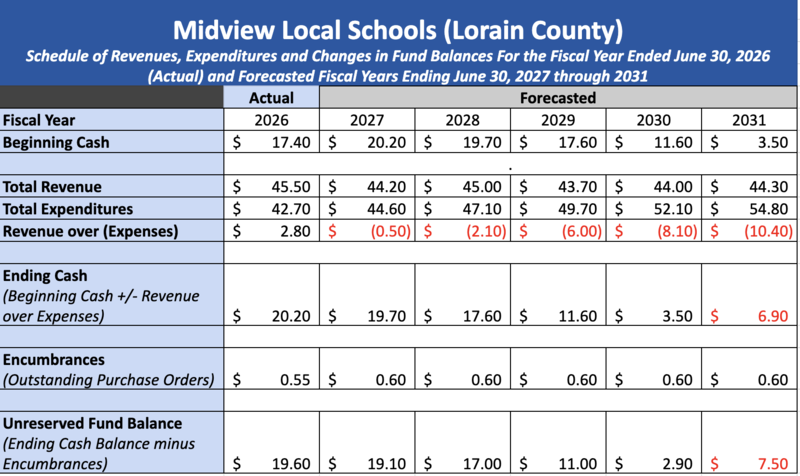 * Excerpt from Financial Forecast. The numbers listed above are in terms of millions.
** The Financial Forecast in its entirety can be found on the Ohio Department of Education & Workforce website as well as our district web page.