
Halloween is full of wonderful opportunities to practice speech and language! Whether you’re trick-or-treating, picking out a pumpkin, or enjoying spooky decorations, you can help your child build communication skills through everyday activities. The best part? Keep it fun, follow your child’s interests, and build language practice into what you’re already doing! There’s no need to set aside extra practice time.
Trick-or-Treat!
Trick-or-treating is a great time to practice social communication, greetings, and useful phrases.
Practice ahead of time: Rehearse phrases such as “Trick or treat,” “Thank you,” and “I’m a dinosaur!” You can also practice answering questions like, “Who are you dressed up as?”
Model communication: Encourage your child to communicate in whatever way works best for them, including talking, signing, pointing, gestures, or using an AAC (augmentative and alternative communication) device.
Make it accessible: If your child uses picture supports or AAC, bring them along! You can prepare Halloween words on their device or carry a small visual card to help with communication.
Remember, communication is more than spoken words. Every attempt to connect is worth celebrating!
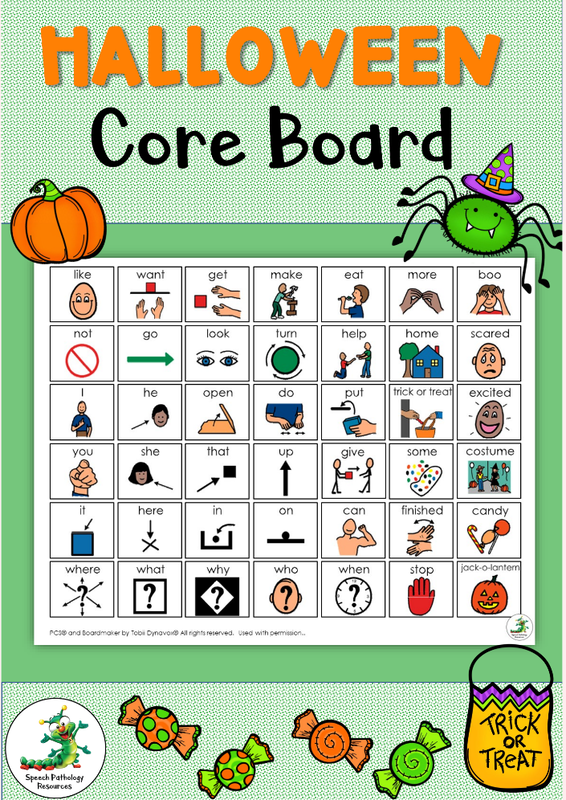
Use the core board below as a guide for Halloween vocabulary to practice. Point to words as you say them during trick-or-treating, while getting dressed up, or when talking about Halloween treats. Your child does not need to use every word; simply seeing and hearing the words modeled is helpful!
Pick, Decorate, or Carve a Pumpkin!
Pumpkin activities are perfect for building vocabulary, describing, following directions, and having fun together. Talk about what you see, feel, and do as you choose or decorate your pumpkin.
While picking a pumpkin, try words like:
Size: big, little, tiny, huge, tall
Shape and color: round, oval, orange, green, white
Texture: smooth, bumpy, rough
Actions: pick, lift, carry, roll, push
Other useful words: heavy, light, up, down, help, wow!
While decorating or carving, try words like:
Actions: cut, scoop, scrape, pull, put in, take out
Describing words: slimy, stringy, sticky, yucky, smooth
Pumpkin parts: top, bottom, eyes, nose, mouth, teeth
Feelings and reactions: happy, silly, scary, “Uh-oh!” and “Wow!”
Easy ways to encourage language:
Talk about what you’re doing. For example, “The pumpkin is bumpy!” or “We’re scooping out the seeds.” This helps your child learn what words mean.
Add a word or two. If your child says “pumpkin,” you can respond, “Big orange pumpkin!” If they say “slimy,” try “Slimy pumpkin seeds!”
Offer choices. Ask, “Big eyes or little eyes?” or “Green hat or purple hat?” Your child can answer with words, gestures, pointing, or AAC.
Ask questions. Try “How does it feel?” or “What should we do next?”
No pumpkin carving planned? No problem! You can practice the same skills with pumpkin stickers, pretend pumpkins, or a picture book.
Practice Speech Sounds During Spooky Fun!
If your child is working on saying certain speech sounds, Halloween provides plenty of fun words to practice! Look for opportunities during play, while reading books, or when spotting decorations around the neighborhood.
Try these spooky sound ideas:
/B/: bone, bat, boo!
/S/: spooky, spider, skeleton
/K/: candy, costume, cat
/F/: fun, Frankenstein
Play “Spooky I Spy!”
Look through a Halloween book or take a walk to spot decorations. Encourage your child to find things that include their target sound. For example, if they are practicing /S/, you might say, “I see a scary skeleton!” or “Look at that spider!”
Remember: Everyday Moments Count!: You don’t need special materials or extra activities to support your child’s communication. Talk about what you see, model useful words, offer choices, and enjoy the moment together. Whether your child communicates with words, signs, gestures, pictures, or an AAC device, your modeling and connection make a difference.